

Welcome back to Inquiry. I’m your host, Kelly Chase.
This episode is going to be a little strange, and a little uneven. That’s because it was conceived out of one of the greatest ruptures of my life. If you’re watching the video version, you’ll notice it’s patchworked together from two different recordings — one from before, and one from after.
I could have fixed that. It would have been easy. But I didn’t want to. Like the Japanese practice of kintsugi — where broken pottery is repaired with lacquer mixed with gold — it felt important to me that the cracks remain visible. Whatever this thing is that we’re building together, the break is a part of it now.
Most of you are probably already aware of the situation that split my life into before and after. But for anyone who doesn’t know what I’m talking about: I recently separated from my former best friend and creative partner following allegations of serious misconduct. My statement about that is in the previous episode, and for now, that’s all I’m going to say about the specifics—out of respect for the community of people who are still coming to terms with everything that has come to light.
But I also don’t know how to not talk about it. Especially because what has unfolded in my life over the past few years worked its way so intimately into my work. This person was my closest friend and confidant—someone I felt I shared a brain and a mission with. And now I find that one of my most trusted lenses was distorted in ways I had been completely blind to. The fallout from that is impossible to avoid. And I wouldn’t want to avoid it. This is a lesson I want to learn. That I need to learn.
The questions that had become consuming to me—what is real? how do we know what is true? what are the conditions under which belief can be manipulated? what is the source and nature of evil?—those questions created a rift in our working relationship. He wasn’t able to follow me there. I wasn’t able to focus on anything else. I understand why, now. I thought our paths were diverging. It turns out we were on a collision course.
In the Gospel of Matthew it is written: “Ask and it will be given to you; seek and you will find; knock and the door will be opened to you.”
When you ask a question hard enough, reality itself bends to answer you. Over the course of the last few weeks, for better or worse, the doors I had been knocking on finally opened. And what I found waiting on the other side changed everything.
In some ways, I’m beginning this episode in the same place I was when I started The UFO Rabbit Hole back in 2021—shaken, humbled, overwhelmed, but resolved to follow this path wherever it leads.
There’s a lot I want to say about everything that has happened, but I don’t even know where to begin. The story is sprawling and murky and dense—and more than that, it’s still unfolding. The walls of the labyrinth are still shifting. The minotaur at its center has only just begun to stir. I don’t know where this is going or how it ends. I’m having faith that the path will reveal itself by walking.
And so that’s where I find myself—at the beginning of a new path, aimed straight into the heart of the dark forest. We’re not going to rush. We’re going to take our time.
I’m going to tell this story rabbit hole style. One step at a time.
And it all starts here—with a conversation about trauma, the phenomenon, and the role that each plays in shaping what we believe about ourselves and the nature of our reality.
——————
This is an important episode—one we’re going to be referring back to often as we move forward. The threads we pull on today run through UFOs, psychological operations, consciousness, anomalous experience, belief engineering, the control system, and the nature of reality itself. Almost everything this show covers connects back to what we’re going to discuss today.
One of the most consistent patterns in the literature on anomalous experience is its relationship to trauma. Granted, it’s not universal. There are plenty of experiencers who will tell you that their encounter had nothing to do with any personal wound they were carrying. But the pattern of trauma leading to or coinciding with anomalous experiences shows up so consistently, across so many different types of high strangeness, that one has to wonder if something about it may be structural to anomalous experience itself. It’s my personal suspicion that understanding what trauma does to human cognition, perception, and belief might actually give us the foothold we need to start building a grand theory of the anomalous that could account for all of it.
Trauma turns out to be a throughline that connects everything in the invisible world we’re trying to explore—not just anomalous experience, but MKULTRA, social media algorithms, social engineering, the shaping of belief at scale, and the history of psychological operations going back decades. What I’ve come to recognize is that talking about trauma and what it does to the human organism is, in a very real way, talking about how reality itself gets constructed.
If that sounds dark, it’s because it is. This work has taken me down darker alleys than I ever would have believed existed, and I want to be honest about that. The implications of what trauma is, what it does, and what certain people have understood about it for a very long time are genuinely frightening. The sheer fact that it emerges as the connective tissue between so many of these topics is enough to make me ask some very uncomfortable questions.
But I promise that my intention with this episode isn’t to black pill you. In fact, it’s quite the opposite. I actually find a lot of reason for hope—maybe even optimism. Because what we’ll see as we move forward is that trauma doesn’t only break people down. It breaks people open. And in choosing to use it as a weapon against us at scale, I believe that the “powers that be” have already set in motion the events that will lead to their own undoing.
Donald Hoffman & The Case Against Reality

To understand how trauma could alter our perception and relationship to reality, we first need to understand how perception actually works—because most of us are operating under a significant misapprehension about how our senses actually operate.
The intuitive assumption is that our senses give us a reasonably accurate picture of the world. It’s not perfect, but it is essentially reliable. We know, in an abstract way, that we can only see a narrow band of the electromagnetic spectrum—what we call visible light—while radio waves, X-rays, and infrared radiation move through the same space completely invisible to us. We know that human hearing covers a limited range of frequencies, while dogs detect sounds we can’t and whales communicate in registers far below what we can register with human ears. But, overall, these feel like minor limitations. What we do perceive, we tend to assume we perceive accurately.
Cognitive scientist Donald Hoffman argues that this assumption is not just incomplete—it is fundamentally wrong. In his book The Case Against Reality,[1] Hoffman draws on evolutionary biology, cognitive science, and quantum mechanics to make a striking claim: our perceptual systems were not designed by evolution to show us reality as it is. They were designed to show us only what we need to survive. And those are two very different things.
His central argument is built on evolutionary game theory. When researchers run simulations pitting organisms that perceive reality accurately against organisms that perceive only what is necessary for their survival, the accurate perceivers lose. It turns out that perceiving everything accurately requires an organism to carry too much information and process too much complexity. And, despite the high cost of this awareness, it doesn’t translate into a survival advantage. Evolution, Hoffman argues, selects for perception that is useful, not perception that is true.
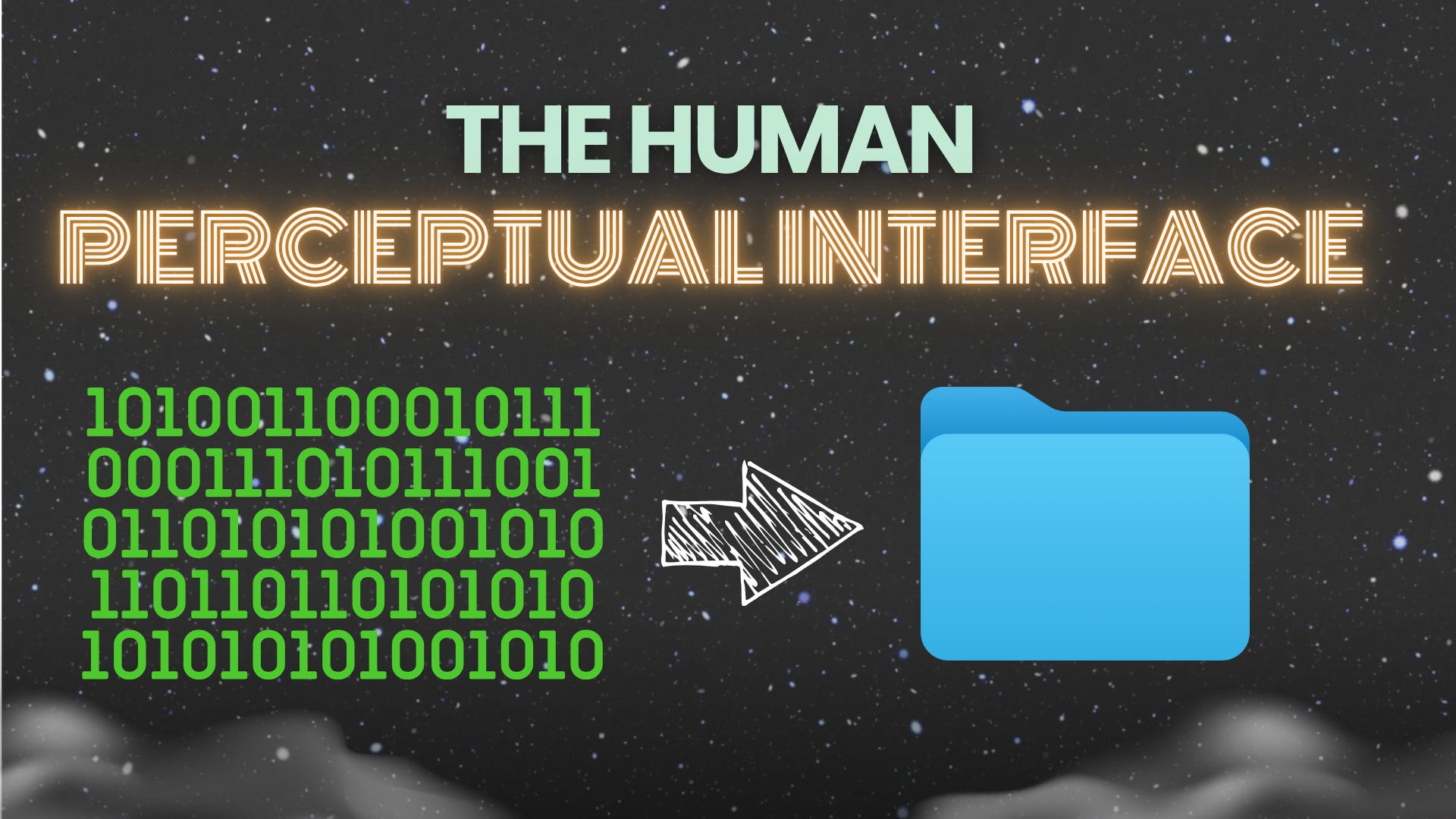
The analogy he uses is a desktop computer interface. When you move a file into a folder on your screen, you are not interacting with what is actually happening inside the machine—the voltage states, the transistor switches, the binary operations executing underneath. You are interacting with a simplified, symbolic representation designed to let you manage those processes without needing to understand them. The folder is not the reality. It is a functional interface. Hoffman’s argument is that human perception works the same way. What we see, hear, and touch is a simplified, species-specific interface with an underlying reality that we are not equipped to perceive directly—and may never be.
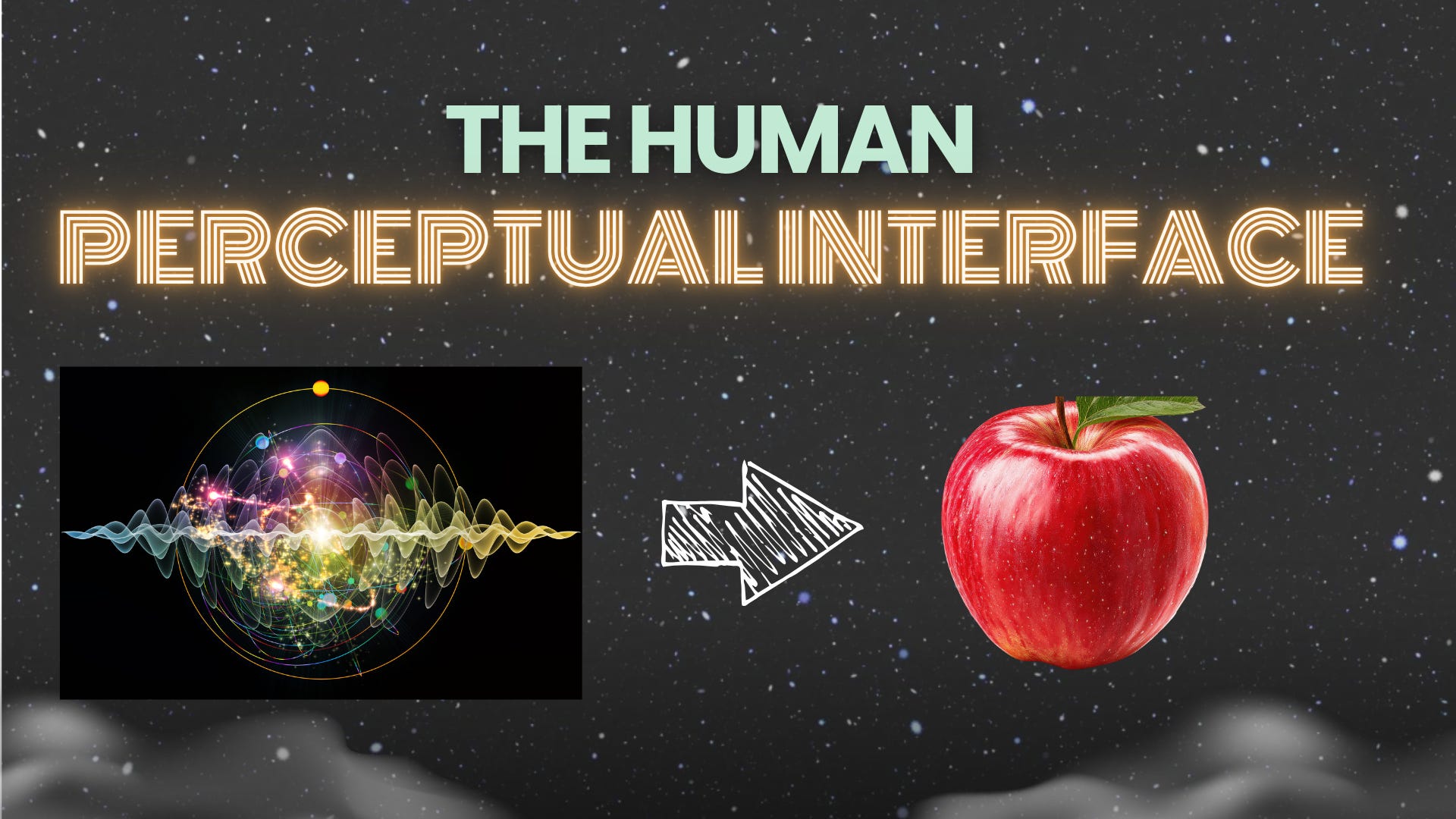
This goes well beyond the limitations of our sensory range. It means that the qualities we experience as inherent properties of the world—color, solidity, distance, the sense that objects persist when we are not looking at them—are constructions. They are features of our interface, not features of reality itself. The redness of an apple is not out there in the apple. It is a rendering produced by a nervous system that needs a fast, reliable way to categorize certain wavelengths of reflected light. The solidity of a table is a model, not a measurement. We experience a table as solid because that representation serves us. What is actually happening at the quantum level when you put your hand on a table is something our perceptual systems were never built to represent.
What Hoffman is describing has direct and radical implications for how we understand anomalous experience. If what we perceive is already a heavily filtered, constructed interface rather than a direct readout of reality, then the question of what lies beyond that interface becomes genuinely open. The filter is not a minor distortion on top of accurate perception. It is the whole show. And if the filter can be altered—by evolution, by circumstance, or by trauma—what we experience as reality can change in ways that are real, even if they don’t fit the consensus model.
The Umwelt and the Über-Umwelt

Before we go any further, I want to bring in a concept that I think adds something essential to this conversation. It comes from James Madden, a philosopher and the author of Unidentified Flying Hyperobject[2]. Madden introduces the concept of the umwelt—a German term meaning something like “around-world” or “nearby world.” The idea is that every organism doesn’t perceive reality as such; it perceives a slice of reality carved out by its own biology—the slice that is relevant to its survival. The world of relevance an organism constructs around itself is its umwelt.
Madden illustrates this with the example of a tick. A tick’s perceptual apparatus is extremely limited: it can sense the butyric acid that mammals release from their skin, detect slight differences in surface temperature, and register physical contact. That’s essentially it. And yet those three signals are enough for the tick to time its drop, locate a host, and find a blood source. The tick’s umwelt works. But it also leaves behind an almost incomprehensible amount of everything else. A human being standing in front of a tick is, to the tick, little more than a warm, acidic surface. All the rest—everything a person is, thinks, feels, carries—is simply not there for the tick. Not filtered out. Never registered at all.

Madden’s point is that we are not different from the tick in any fundamental way. We have a perceptual apparatus that evolved to perform specific tasks that were adaptive for humans, and it does that largely by ignoring enormous quantities of everything else. Which should make us ask: what are we missing? In the same way that the tick is oblivious to the very blade of grass it clings to, we may be oblivious to things that are genuinely present in our environment—things that are simply outside the narrow band of reality our senses were built to register.
This leads Madden to what he calls the über-umwelt—a super around-world, the sum total of what actually exists beyond any single organism’s perceptual slice. Every umwelt is carved out of this larger space. We live inside our umwelt, but that doesn’t mean we couldn’t, under certain conditions, stumble into something from outside it. And if we did, Madden argues, we would have no framework for it. It would be fundamentally uncanny—something that doesn’t make sense, that seems to violate the basic rules of our experienced reality. We would reach for the nearest available word: ghost, fairy, spirit, Sasquatch, UFO. Not because those words are accurate, but because they’re what we have for experiences that arrive from beyond the edges of our constructed world.
What Madden is describing is not a mystical claim. It’s a logical extension of what we already know about how perception works. Every organism, including us, navigates a slice of reality—the slice that evolution decided was relevant enough to render. Everything outside that slice does not cease to exist. It simply goes unregistered by our senses. We don’t perceive it, so we don’t think about it, and eventually we stop believing it could be there at all.
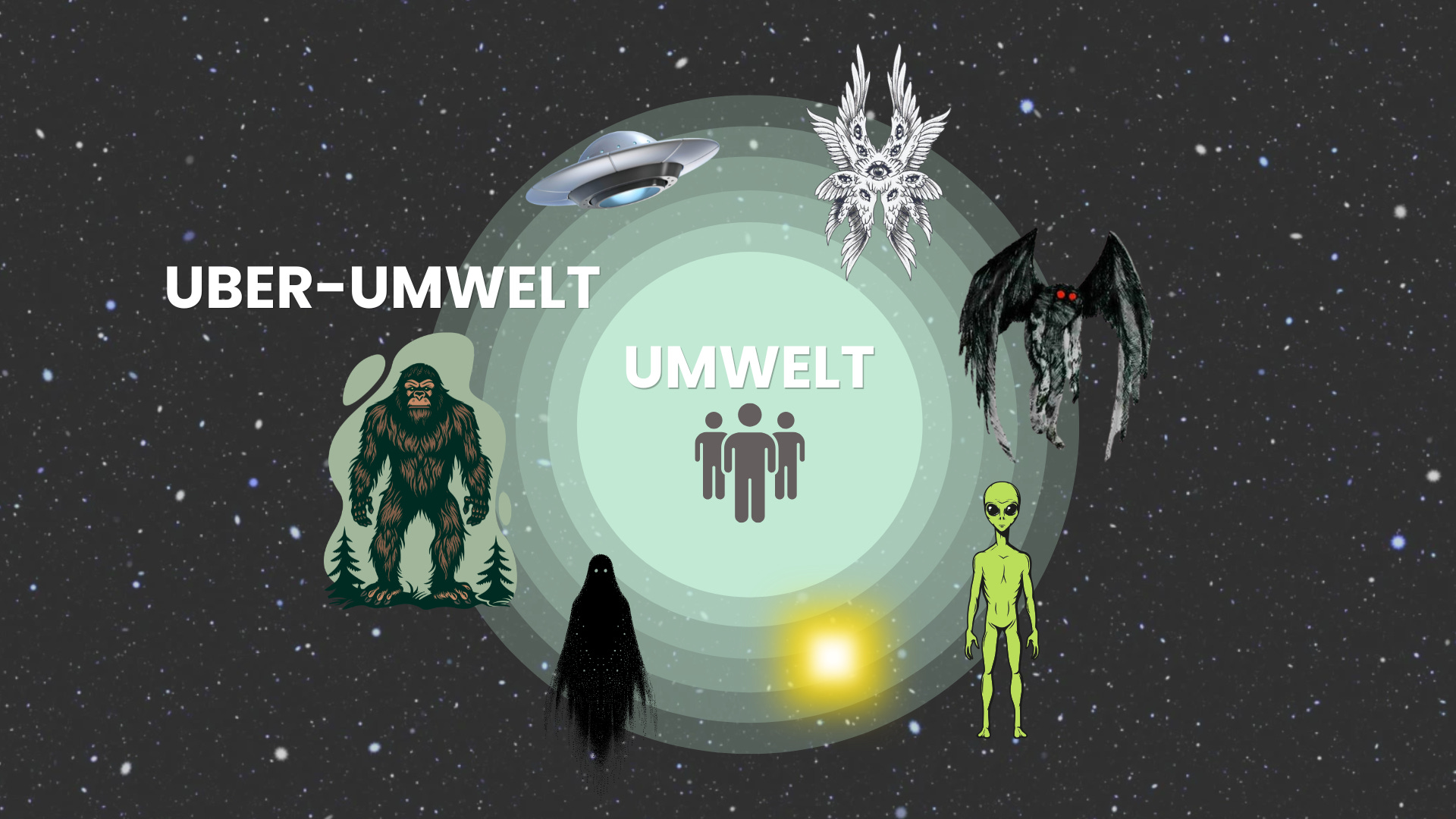
But the über-umwelt doesn’t disappear because we stopped looking for it. And if something from outside our perceptual slice were to intrude—if the filter slipped, even briefly—we would have no framework for it—no category, no language. We would reach for the nearest available word: something like “ghost,” “fairy,” “alien,” or “UFO,” because those words are the best descriptions we have for those kinds of experiences. But our ability to understand how accurate those words are is severely limited by the fact that they exist almost entirely outside of our ability to perceive them. That complicates things.
But still, it could be that anomalous experiences may be real encounters with aspects of reality that our perceptual systems were never designed to process—and that under certain conditions, those systems let things through that they normally would not.
Which brings us to the Filter Thesis.
The Filter Thesis
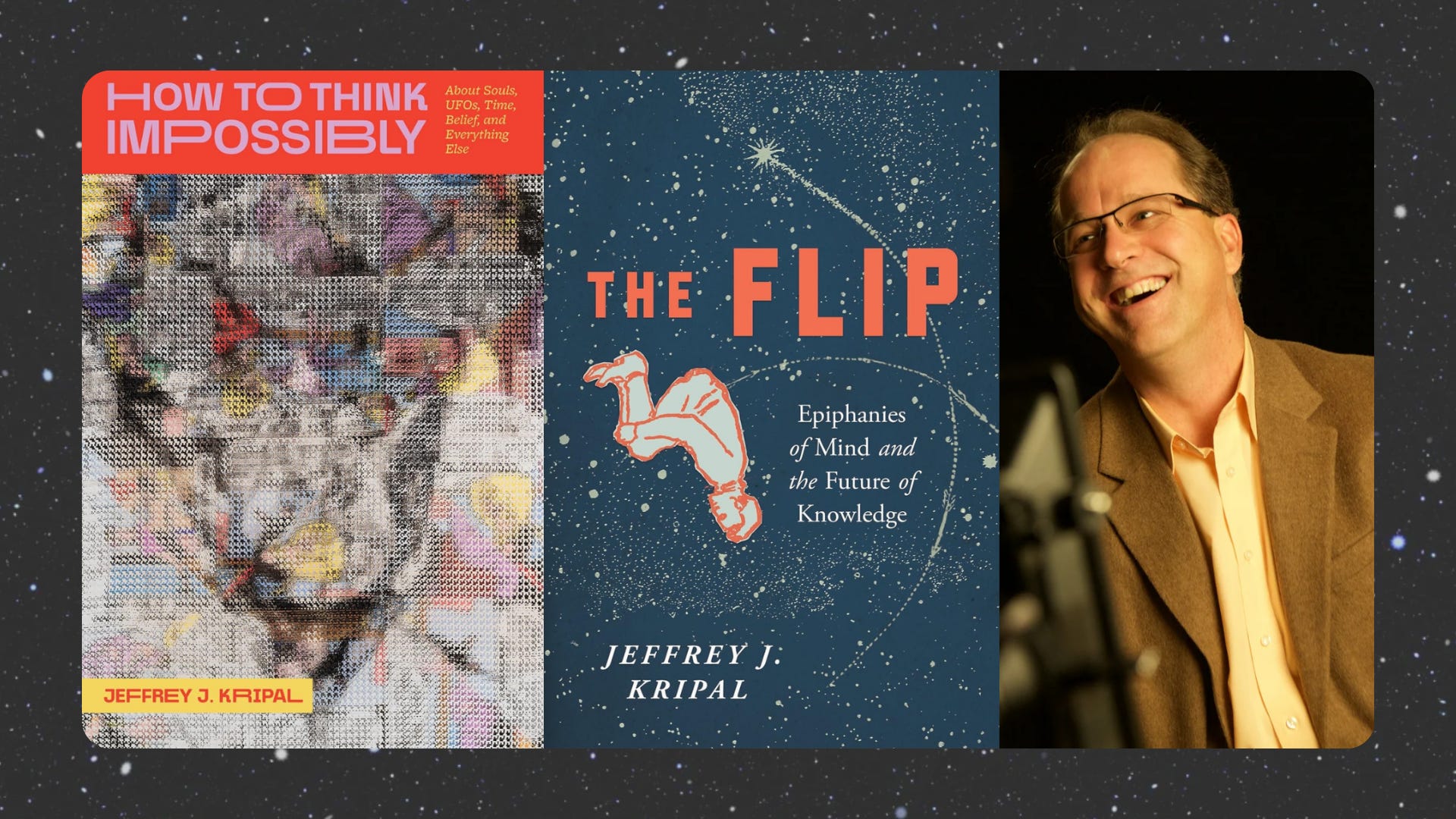
The concept has a name, and Jeffrey Kripal articulates it with particular clarity. Kripal is the author of How to Think Impossibly[3] and The Flip[4], and what he calls the filter thesis begins exactly where Hoffman and Madden leave off. Kripal argues that the fact that our senses don’t deliver an objective window into reality can help explain not only why anomalous encounters feel so uncanny—so fundamentally wrong, so difficult to categorize—but also why they so often arise in the wake of trauma. The connection isn’t incidental. Trauma, in Kripal’s framing, pokes a hole in a person. The suffering doesn’t cause the anomalous experience so much as it makes the person more porous—more open to dimensions of reality that were always there but previously unavailable. The wound creates a kind of permeability.
Behind that is the deeper claim Kripal calls the filter thesis: the body and brain don’t produce consciousness. They mediate it. They filter it—actually reduce it down to something manageable, something that functions as a coherent self moving through a world that appears stable and bounded. Consciousness, in this view, is not something the brain generates; it’s something the brain narrows. And what trauma does, among other things, is damage that narrowing apparatus. When the filter takes a serious enough hit, what it was successfully excluding can begin to come through.
What Kripal is suggesting here is that the anomalous is not something that intrudes into our ordinary reality. It is something that exists within our normal reality, that our brain normally filters out. The brain’s job, in this framework, is not to open us up to the fullness of what exists. It is to narrow it down into something functional and manageable—something that feels like a stable, coherent self moving through a stable, coherent world.
Trauma can damage these filters in a variety of ways. When the filter takes a hit, what was always there just outside its edges can sometimes start to come through.
The Filter Thesis proposes that anomalous experiences emerge when this process is disrupted—when our natural filters weaken, shift, or fail. Under those conditions, aspects of experience that are normally excluded from awareness can intrude: unusual perceptions, altered states, synchronicities, or encounters that feel as though something “more” has broken through. Whether those experiences are interpreted as psychological, spiritual, or non-human depends largely on cultural context and personal belief. What matters for our purposes is the mechanism: a change in how perception is regulated, not necessarily a change in what exists.
In this framework, the question is not “Why do some people experience the anomalous?” but rather “Why don’t most people?” And this flip alone is enough for us to begin to revive what materialism has so unceremoniously trampled.
Trauma and the Anomalous
One of the most consistent patterns in the literature on anomalous experience is its relationship to trauma. Again and again, anomalous events are reported in the wake of destabilizing life experiences—things like childhood abuse, serious illness, near-death experiences, combat exposure, prolonged stress, or sudden loss. This correlation appears across cultures and across different types of anomalous phenomena, from psychic experiences to contact events to profound altered states. While this pattern is often noted in passing, it is rarely examined in depth.
Equally striking is the tendency for anomalous experiences to cluster around particular individuals. People who report one type of anomalous experience are significantly more likely to report others over time. These generally aren’t isolated incidents that happen once in a person’s life and then never again. For many experiencers, anomalous perception becomes a recurring feature of their lives. When trauma histories are examined alongside these reports, they appear with enough regularity to raise an important question: whether trauma is merely correlated with anomalous experience, or whether it plays an active role in shaping the conditions under which such experiences occur.
It is also important to acknowledge that anomalous experiences themselves can be deeply traumatic. This is true even when they are described as meaningful, transformative, or positive in retrospect. Sudden violations of reality, loss of perceived control, disruptions of time and memory, and encounters that defy existing belief systems can overwhelm the nervous system. Many experiencers struggle not only with the content of what happened, but with the aftermath. It’s common for people to be overwhelmed by a sense of confusion, a fear of being dismissed, increased isolation, and the destabilizing realization that their understanding of reality may no longer hold. In this sense, trauma and anomalous experience often form a feedback loop, each shaping the other.
If anomalous experiences were simply hallucinations or cultural fantasies, this pattern would be difficult to explain. It’s an answer that doesn’t really provide an answer, it just makes the answer meaningless by assuming that anything not acknowledged by consensus reality must be hallucinations. I’d argue that the more plausible explanation is that trauma changes something fundamental about how perception operates. To understand how that might happen, we need to look more closely at how the brain normally filters and organizes reality in the first place.
What Trauma Does to the Brain’s Filters
To understand how trauma might weaken this perceptual filter, it helps to look at how the brain normally decides what to pay attention to. Contemporary neuroscience increasingly describes the brain as a prediction engine. Instead of building reality from scratch each moment based on real-time sensory inputs, the brain starts with expectations—internal models of how the world usually works—and then checks incoming sensory information against those expectations. When what we see or hear matches the model, the brain barely needs to register it. When something doesn’t match, the brain flags it as a potential problem and decides whether it is important enough to update the model. This is the process that is always going on underneath the surface when we are perceiving our environment.
Neuroscientist Karl Friston’s influential free energy principle describes the brain as fundamentally a prediction machine—one whose core function is to minimize the gap between what it expects and what it receives.[5] Crucially, when that gap is small, the brain doesn’t need to update its model to match the world. It suppresses the incoming signal to match the model. This means that what you experience as perception is, in large part, the brain’s best current guess about what is there based on previous experience.
The classic demonstration of this is the way that your brain automatically fills in the natural blind spot in your eye. The point where the optic nerve connects to the retina has no photoreceptors at all, yet you perceive no hole in your visual field because your brain generates what it expects to be there.
Under ordinary conditions, this system is heavily biased toward stability. The brain trusts its expectations more than raw sensory input. This is efficient and usually adaptive. It keeps us from being overwhelmed by noise and allows us to move through the world without constantly questioning what we are seeing.
In the paper Trauma or Drama: A Predictive Processing Perspective on the Continuum of Stress[6], psychologist Valery Krupnik explains how trauma can disrupt this balance. Under chronic stress or traumatic conditions, the brain’s predictive models can become unreliable. When the world repeatedly violates expectations—when danger appears suddenly, unpredictably, or without clear cause—the brain learns that its prior assumptions cannot be trusted. In response, it may reduce how much weight it gives to expectations and increase how much weight it gives to incoming sensory information. In simple terms, the brain becomes less confident in what it thinks should be happening and more alert to what actually seems to be happening.
This shift has consequences. When expectations lose their dominance, perception becomes more sensitive, more vigilant, and more open-ended. The brain is less likely to automatically explain away unusual stimuli or force them into familiar categories. Small anomalies that would normally be dismissed as irrelevant may stand out instead. Patterns may appear where none were consciously noticed before. Experiences that feel “off,” uncanny, or difficult to categorize may break through awareness rather than being filtered out.
The argument here isn’t that trauma grants special insight or mystical perception. It’s that trauma can alter how perception is weighted. The brain may rely less on preexisting models and more on raw data. This can be destabilizing and distressing—and often is—but it also creates a cognitive environment in which the unusual is harder to ignore. Within the framework of the Filter Thesis, this provides a plausible, non-mystical mechanism for why people with trauma histories may report heightened sensitivity to anomalous experiences. The filter is not gone. It is simply no longer doing its usual job quite as aggressively.
A Foothold, Not an Answer
I want to take a moment to be clear about something: trauma is not the whole story. Many people who have experienced significant trauma never report anything anomalous, and many experiencers are adamant that trauma has nothing to do with what happened to them. Reducing anomalous experience to a trauma response would be as intellectually dishonest as dismissing it as one. That is not what we are doing here.
What trauma gives us is a foothold. It is a place where the anomalous intersects with things we already have scientific language for—predictive processing, perceptual weighting, and the constructed nature of consensus reality. It lets us ask better questions. Not “did this really happen” but “what are the conditions under which perception shifts, and what might become available when it does.”
There is also a darker reason this matters. If trauma can alter how a person perceives and relates to reality—not just what they think, but how their nervous system constructs the world around them—then trauma is not only a wound. It’s a lever. And there are people who understand precisely how to pull that lever to control human belief systems.
Trauma and the Malleability of Belief
Because here’s the thing: trauma doesn’t just have the capacity to disrupt how people perceive reality, it can also disrupt the frameworks people use to interpret what they perceive. And in doing so, trauma literally alters the conditions under which belief is formed and maintained.[7]
Psychological research has long recognized that human beings operate within what are often called assumptive worlds—deep, largely unconscious beliefs about how reality works. These include expectations about causality, predictability, fairness, agency, and authority. Under ordinary conditions, these assumptions function as stabilizing structures, allowing experience to be interpreted quickly and coherently without constant reevaluation. Research on trauma consistently shows that these assumptions are especially vulnerable to disruption following events that violate expectations about how the world should behave.[7][8]
When a traumatic event contradicts core assumptions—when reality behaves in ways that cannot be reconciled with existing frameworks—those assumptions lose their organizing power. This doesn’t simply produce emotional distress. It destabilizes belief itself. Studies of trauma as meaning violation show that such events force a reassessment of what can be trusted, what explanations remain viable, and what models of reality are capable of accounting for what has occurred.[9]
Importantly, this destabilization does not point toward any particular belief system. Trauma does not determine what someone will come to believe. What it does is loosen the grip of previously held frameworks. Belief becomes more provisional. Interpretive boundaries soften. Explanations that would once have felt implausible or irrelevant may now appear possible, even necessary, while narratives that once carried authority may lose their credibility.[9][10]
This shift is well documented. Research on belief disruption and meaning violation consistently shows that traumatic experiences exert pressure on global belief structures—beliefs about the self, the world, and the nature of reality itself. These are not minor cognitive adjustments. They represent changes at the level of orientation: how experience is sorted, prioritized, and made intelligible.[7][9]
Under these conditions, belief systems become more malleable. This malleability doesn’t only express itself as skepticism or questioning. Research on post-traumatic meaning-making shows that it can also produce a heightened pull toward belief structures that restore coherence, purpose, or certainty in the wake of disruption.[10][11] Some people respond by rejecting inherited narratives; others respond by gravitating toward new explanatory frameworks that offer meaning, order, or orientation. Spiritual, ideological, metaphysical, or cosmological systems can become especially compelling when they succeed in filling the vacuum left by shattered assumptions. The unifying feature is not the direction of belief change, but the fact that belief itself has become unmoored from its previous anchors.
For experiencers, this process is often familiar. Anomalous experiences rarely occur in isolation from broader shifts in meaning. They tend to coincide with periods of psychological, emotional, or existential disruption, when previous assumptions are already under strain. Research linking trauma exposure to changes in worldview, spirituality, and existential orientation suggests that trauma does not merely accompany anomalous experience; it prepares the ground by weakening the structures that normally constrain interpretation.[11]
What emerges from this literature is a simple but consequential point: trauma creates conditions in which belief is more easily reshaped. It does so by undermining the taken-for-granted assumptions that ordinarily regulate perception and meaning. Once those assumptions are disrupted, belief becomes a site of negotiation rather than certainty.[7][9]
This observation matters because belief is not neutral. It shapes attention, expectation, memory, and action. When belief systems become malleable, they become susceptible—to insight, to reinterpretation, and, as history makes clear, to influence.
Once belief is understood as something that can be destabilized and reorganized, it becomes a matter of control. Belief determines how people interpret events, whom they trust, what they consider legitimate, and how they respond to authority. Influence over belief produces compliance, alignment, or resistance—and at scale, that influence functions as power. For governments and military institutions, this makes belief not just a psychological concern, but a strategic one.
MindWar and the Explicit Targeting of Belief
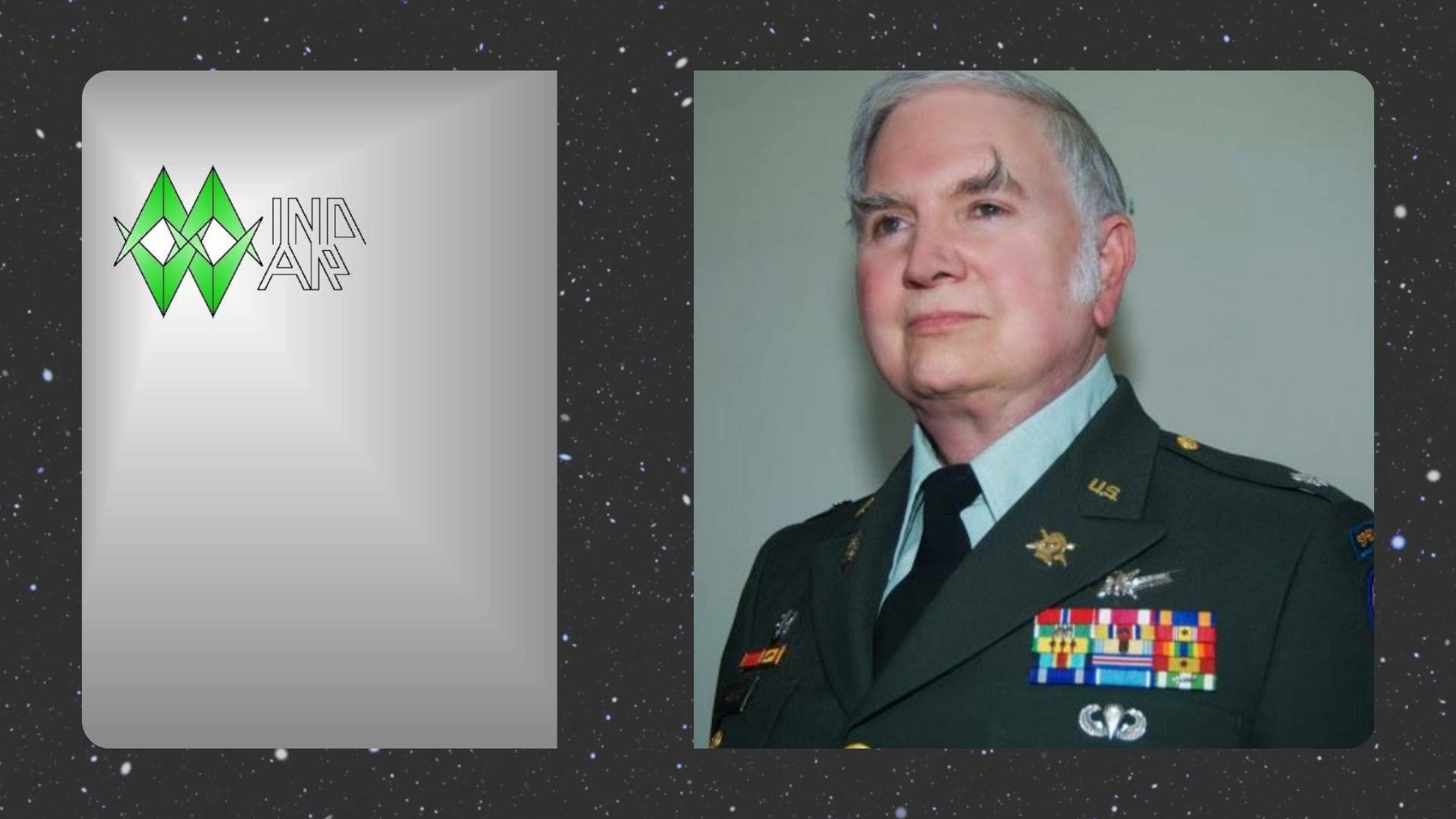
By the late twentieth century, the idea that belief itself could be treated as a strategic variable was no longer implicit. It was being stated outright.
One of the clearest examples appears in From PSYOP to MindWar: The Psychology of Victory[12], a paper written in 1980 by Colonel Paul E. Vallely and Lieutenant Colonel Michael Aquino of the U.S. Army’s 7th Psychological Operations Group. The paper circulated internally within military and intelligence contexts and later became publicly known after it was leaked and discussed in defense and intelligence circles. It was later published in 2016 in book format by Aquino.[13] It was not speculative fiction, nor was it written from outside the system. It reflects how psychological operations were being conceptualized from within.
Aquino defines MindWar as follows:
“MindWar is the psychological and psychophysiological conditioning of all participants in a sociopolitical problem, first to cooperatively stabilize it without recourse to violence, then to eliminate its basis by the creation of a moral community to supercede it.” [13]
This definition is often presented as benign—even humanitarian. MindWar is framed as a way to prevent violence, to stabilize conflict, and to resolve sociopolitical problems without bloodshed. But the means by which this is to be accomplished are far more revealing than the stated goal.
Aquino is explicit about what MindWar actually targets:
“MW controls human external-action thoughts by identifying and adjusting the sensory impressions that the mind uses to assemble, modify, and reinforce them. Humans’ sensory-based thoughts form the basis for their constructed outward personalities, and in groups their mores, biases, traditions, habits, and taboos. Thus through a graduated process, MW controls groups of humans.” [13]
This is not a description of persuasion. It is not even a description of propaganda in the traditional sense. It is a proposal to intervene at the level of perception and interpretation—to shape the sensory inputs and meaning structures from which beliefs, identities, and cultural norms are constructed. In other words, it is an explicit strategy for controlling belief by controlling the conditions under which belief forms.
What is notably absent from this framework is any meaningful consideration of cognitive sovereignty—an individual’s right to control their own neural processes, thoughts, and consciousnes. The violence MindWar claims to prevent is defined narrowly as physical conflict or overt instability. The violence it introduces—systematic interference with perception, belief formation, and meaning-making—is treated as either negligible or without ethical weight. Yet from the perspective of the individual, this represents a profound violation. To deliberately manipulate the sensory and interpretive foundations of a person’s worldview is to violate autonomy at its most fundamental level.
It is also important to note that MindWar is presented as a solution to the threat of violence—but the threat of violence comes from the same institutions proposing it. The logic is simple and coercive: people must accept the manipulation of perception and belief, or face the instability and violence that refusal would invite. To be clear, this is not conflict resolution. It’s a hostage situation in which belief compliance is exchanged for the promise of safety, and the authority to define both the danger and the remedy is held by the same actors.
Placed in historical context, MindWar does not represent an aberration. This is simply how the sausage is made. It makes explicit what had already become implicit across intelligence, defense, and psychological operations: that belief is not merely influenced by power, but is itself a resource to be managed, stabilized, and, when necessary, reshaped.[13] This matters because it shows that within the military intelligence community, belief manipulation has been articulated as a legitimate tool of governance.
But this mindset didn’t appear out of nowhere. If we look further back in time we can find evidence of programs that treated trauma and perceptual disruption not just as tools—or perhaps more accurately, as weapons. Programs like MKULTRA did not emerge in a vacuum. They were part of the same institutional trajectory and legacy that inevitably led us to MindWar.
MKULTRA, Mockingbird, and the Institutional Pursuit of Belief Control
Long before MindWar articulated belief manipulation as doctrine, U.S. intelligence agencies were already exploring it experimentally. The most well-documented example is Project MKULTRA, a covert CIA program initiated in the early 1950s and formally exposed through congressional investigations in the 1970s.[14]
MKULTRA was not a single experiment, but a broad umbrella covering more than a hundred subprojects conducted across universities, hospitals, prisons, and military facilities. According to Senate testimony and declassified records, its stated purpose was to investigate methods of behavior modification, interrogation, and psychological influence.[14] What makes MKULTRA relevant here is not speculation about its more extreme claims, but what is explicitly acknowledged: the program sought ways to disrupt cognition, perception, and belief in order to render individuals more malleable.
Among the techniques explored were the administration of high-dose psychedelics without informed consent, sensory deprivation, isolation, sleep disruption, hypnosis, and psychological stressors.[14][15] These methods were not incidental. They reliably produce disorientation, depersonalization, derealization, and a breakdown of ordinary meaning structures—the very conditions psychological research associates with belief destabilization. In other words, MKULTRA systematically attempted to induce the same kinds of perceptual and interpretive ruptures that trauma produces organically.
Crucially, the program’s architects were not operating under the assumption that belief was fixed or inviolable. The working premise was that belief, identity, and agency could be disrupted, reshaped, or overridden under the right conditions. Although the CIA later claimed that MKULTRA failed to achieve its more ambitious goals, that retrospective assessment, honest or not, doesn’t negate the significance of the attempt. The program demonstrates that trauma-induced belief malleability was not only recognized, but actively pursued as a tool.
If MKULTRA represents the experimental phase of this logic at the level of the individual, Project Mockingbird reflects its application at the level of information and narrative. Investigations by the Church Committee established that the CIA maintained covert relationships with journalists and media organizations, both domestic and international, for the purpose of influencing public perception during the Cold War.[16] While the extent, coordination, and continuity of these efforts have been disputed, MindWar makes one point explicit: effective psychological warfare depends on controlling the informational environment in which belief forms. From that perspective, the idea that such practices were more widespread than publicly acknowledged—or that they have expanded and evolved over time—is not speculative excess. It follows directly from the logic of belief control itself.
Taken together, MKULTRA and Mockingbird reveal a consistent throughline. Belief was not treated as a byproduct of persuasion or education, but as something that could be shaped. Whether through psychological disruption at the individual level or narrative influence at scale, the objective was the same: to guide how reality itself was interpreted.
What is striking in retrospect is how little attention was paid to the ethical cost of these efforts. The violence MKULTRA and Mockingbird were meant to prevent was framed as justification enough. The damage done to individuals subjected to non-consensual experimentation, and to populations exposed to covert narrative manipulation, was treated as unfortunate but necessary collateral damage or simply ignored.
Bidirectional Mimicry and the Control System
What becomes difficult to ignore, once these patterns are laid side by side, is that belief shaping through disruption is not confined to human institutions. Similar mechanisms appear to be operating at the level of the anomalous itself, suggesting that the use of trauma and destabilization to influence belief may be occurring simultaneously from both human and non-human sources.
I first encountered the concept of bidirectional mimicry at the Archives of the Impossible conference at Rice University in May 2023, where it was presented by Colm Kelleher as a way of thinking through a recurring pattern in the phenomenon. Bidirectional mimicry is useful here not because it explains confusion or ambiguity, but because it points to a deeper structural dynamic. As Kelleher described it, human and non-human actors appear to mirror one another’s technological signatures and behaviors, creating situations in which attribution collapses. What matters is not who is copying whom, but what this interaction does to human perception, belief, and meaning.
Within ufology, black triangle craft are often treated as evidence of secret human technology—advanced platforms developed within black budget programs, potentially incorporating elements of reverse-engineered non-human systems. At the same time, these craft are repeatedly observed behaving in ways that contradict how genuinely sensitive technology is protected. Low, slow flights over residential neighborhoods, prolonged visibility near highways, and repeated public exposure do not align with the logic of secrecy. These behaviors generate dissonance rather than confirmation. They disrupt expectations rather than resolve them.
Kelleher’s proposal is that this disruption is not accidental. Humans may be mimicking non-human technology through reverse engineering, while non-human intelligences may be mimicking human technological forms and deployment patterns. The result is a feedback loop in which the boundary between human and non-human agency becomes unstable. But the deeper consequence is not confusion about origin. It is pressure on belief.
This is where Jacques Vallée’s control system hypothesis becomes relevant.[17] Vallée has long argued that the UFO phenomenon is less about discrete objects or visitors and more about a regulatory process—one that shapes human belief, culture, and meaning over time. Within this framework, anomalous encounters function not simply as sightings, but as interventions that destabilize consensus reality and force reinterpretation. They operate as shocks to belief systems.
When viewed alongside the historical record of human psychological operations, a striking parallel emerges. MKULTRA explored trauma and perceptual disruption as a means of rendering individuals cognitively malleable. MindWar formalized belief manipulation as doctrine, explicitly targeting perception and meaning as strategic terrain. These efforts were not about information alone. They were about inducing conditions—disorientation, rupture, destabilization—under which belief could be reshaped.
Bidirectional mimicry suggests that similar mechanisms may be operating from the non-human side as well. Not through direct instruction or overt control, but through experiences that disrupt perception, fracture assumptions, and destabilize meaning. Trauma, in this context, is not incidental. It is functional. It weakens the structures that normally regulate belief and opens a space in which new interpretations must be constructed.
Seen this way, the overlap between human and non-human strategies is not accidental. Both appear to rely on the same lever: the use of disruptive experience to alter belief. The scale and intent may differ. The ethical frameworks may differ (or may not). But the mechanism is shared.
This reframes the question at the center of anomalous research. The issue is not simply whether human institutions have manipulated belief, or whether non-human intelligences exist and interact with us. It is whether human belief itself has become the terrain on which multiple forms of agency operate—using trauma, disruption, and anomaly as tools to shape how reality is understood.
If that is the case, then the phenomenon is not only about what people experience. It is about how belief is engineered in the aftermath of disruption—and about what it means to live in a world where control operates not just through force or persuasion, but through the destabilization of meaning itself.
Hubris
I want to pause here to acknowledge that this discussion has gotten pretty dark—and things are about to get a little bit darker still.
But here’s the thing about the dark night of the soul—that moment in every story where all hope seems to be lost and the villain is about to walk off with the spoils. The moment where the hero is on the ground and the audience genuinely isn’t sure they’re getting back up. It’s that moment, without exception, when the tide begins to turn.
And that is where we find ourselves in this journey. Despite how things may appear, all hope is not lost! Because when we closely examine the insidious mechanisms designed to control us, we find that they may just have planted the seeds of their own undoing. In making the move to weaponize trauma against humanity at scale, the powers that be have unleashed something that they can’t control.
Like so many archetypal villains, their greed will be their undoing. They wanted too much, they flew too close to the sun. The Greeks have a word for that kind of overreach. It never ends well.
The Pressure Cooker
If you can engineer belief through trauma on an individual level, the logical next move is to engineer it at scale. And there is very little reason to think that this move hasn’t been made.
Now, I recognize that the moment I say something like that, a certain percentage of people will immediately cry “conspiracy theory” and use it as a reason to stop listening. So I want to be clear about what I am and am not claiming, because I don’t actually need to speculate or dive into conspiracies. The documented historical record is more than sufficient to make the point.
In 1962, the Joint Chiefs of Staff drafted a proposal—signed by Chairman Lyman Lemnitzer and submitted to the Secretary of Defense—recommending that the CIA stage a series of terrorist attacks on American soil and blame them on Cuba in order to build public support for a military invasion.[18] The document proposed bombing civilian targets in Miami and Washington. It proposed sinking boats carrying Cuban refugees. It proposed fabricating the shoot-down of a U.S. passenger aircraft, going so far as to detail how a remote-controlled drone could be substituted for a real commercial flight, which would then “disappear” while the drone was destroyed over open water. False evidence linking Castro to the attacks would be planted and given to the press. The whole operation was designed, in the words of the document itself, to “psychologically condition the public” to accept a war they would otherwise oppose.
President Kennedy rejected the plan. The documents remained classified for 35 years, finally becoming public in 1997 through the JFK Assassination Records Collection Act, and receiving wider attention in 2001 when journalist James Bamford published them in his book Body of Secrets.[19] Defense Secretary Robert McNamara, reflecting on the period later, said of the military officers behind Northwoods: “We had people proposing things that were completely insane.”
This is not a conspiracy theory. It is a declassified government document, available at the National Security Archive at George Washington University, signed by the Chairman of the Joint Chiefs of Staff. What it establishes is that false flag operations—staged crises designed to manipulate public belief and manufacture consent for predetermined outcomes—are not the invention of paranoid imaginations. They are, and have been, a recognized tool in the toolkit of American military and intelligence planning. Kennedy said no in 1962. The question of what has happened in administrations less inclined to say no is one that the historical record doesn’t fully answer, and probably never will.
What we can say with confidence is this: the idea of using manufactured or leveraged crises to shape public perception and belief is not something that has to be inferred or imagined. It was explicitly proposed, in writing, at the highest levels of the U.S. government. And if it was proposed once, with that level of institutional seriousness, the burden of proof shifts considerably when we ask whether similar logic has been applied since.
There is almost certainly a spectrum here: at one end, manufactured events—crises that are designed and staged from the ground up. At the other, opportunistic exploitation—real crises, or crises allowed to unfold, that are then shaped and amplified by the systems that control information. We don’t need to resolve exactly where any particular event falls on that spectrum to recognize that the spectrum exists, and that institutions with the motive, the means, and the documented willingness to consider such options are not going to simply stop having those options available to them.
But here’s the thing: even if we set all of that aside entirely, there is a second mechanism of mass trauma delivery that doesn’t require any orchestration at all. It has been built into the architecture of the platforms that billions of people use every single day, and it is operating continuously, right now, in ways that are extremely well documented. And the scale and consistency of it is genuinely staggering.
A four-wave nationally representative study tracking American adults throughout 2024 found that roughly four in ten Americans reported experiencing at least one significant stress reaction related to politics in any given month.[20] Around 17 percent—approximately 44 million people—reported losing sleep over politics on a regular basis. And what most surprised the researchers was not the numbers themselves, but their stability: political stress levels barely moved across the year despite a calendar packed with dramatic events. In other words, the stress wasn’t being driven by the news anymore. It had become the baseline.
Separate surveys conducted by political scientist Kevin Smith at the University of Nebraska found that 40 percent of U.S. adults cited politics as a major stressor, with one in twenty reporting suicidal thoughts they attributed to political events.[21] As Smith noted with some dark irony: if a consumer product generated those numbers, there would be federal investigations and emergency hearings. When politics generates them, we largely treat it as normal.
It isn’t normal. And it isn’t accidental.
What social media platforms have built—and what the research consistently confirms—is a system that takes the natural human response to threat, amplifies it continuously with algorithmically selected content, and delivers it in an unresolved, unrelenting stream that never reaches a conclusion. The threat-detection system gets activated. Then it gets activated again. And again.
Without resolution, without the kind of acute rupture that might force genuine cognitive reorganization, the nervous system simply adapts to a permanent state of low-grade alarm. The default mode becomes chronic vigilance and background dread—the sense, which many people report having difficulty even articulating, that something is deeply wrong and getting worse, and that there is nothing to be done about it.
This is, from the perspective of belief management, close to optimal. A chronically stressed population is reactive, tribal, and highly susceptible to narratives that offer an explanation for the dread they already feel. It is not, crucially, a population that is positioned to think clearly. The predictive processing research we covered earlier is precise about this: chronic stress narrows perception rather than opening it. It trains the brain to look for confirmation of the threat it already expects. It makes people easier to steer, not harder.[22]
And yet—and this is where the hubris comes in—it also does something else. Something the engineers of this system may not have fully accounted for.
A Messy Business
Here’s the thing about sustained stress at the scale we’ve been living through: it doesn’t only produce the effects it’s designed to produce. The research on how chronic adversity affects human psychology tells a more complicated story than the one the belief-management playbook assumes.
Psychology has a concept called openness to experience—one of the five core personality traits in what researchers call the Big Five model of personality. It describes a cluster of qualities: intellectual curiosity, imaginative thinking, sensitivity to experience, comfort with ambiguity, and what researchers call a fluid style of consciousness that allows for novel associations between ideas that wouldn’t normally be connected. People high in openness are more likely to question inherited assumptions, seek out new frameworks for understanding the world, and sit with uncertainty rather than retreating to the familiar.
What multiple independent research groups have now found, across different populations and different methodologies, is that stressful life events are consistently associated with increases in openness to experience.[23] This doesn’t mean that stress is good for you—there’s plenty of evidence for the opposite. But it does mean that adversity has a documented tendency to break people open in ways that go beyond what the architects of that adversity intended.
The “shattered assumptions” theory, developed by Janoff-Bulman, proposes exactly this mechanism: that major stressful events, particularly those perceived as unjust or random, force people to reassess the core beliefs they held about the world, and that this reassessment is what drives the increase in openness.[8] When the old frameworks fail to account for what’s happening, the mind begins looking for new ones.
This is a paradox embedded in the very logic of using mass stress as a control mechanism. Yes, chronic stress narrows perception, creates hypervigilance, and makes populations reactive and tribal. All of that is true and documented. But it also—simultaneously, in the same people—begins to loosen the grip of the assumptions that made them manageable in the first place. The stress that is meant to keep people distracted and compliant is also, over time, quietly eroding the foundations of the belief systems that compliance depends upon.
And it gets more interesting than that.
Research on Post-Traumatic Growth has established that trauma’s most documented positive outcome is a change in what researchers call “new perspectives on spiritual and existential issues.”[24] Not resilience, not better coping strategies—though those appear too—but a fundamental reorientation toward the deepest questions about what is real, what matters, and what kind of world we actually inhabit. Tedeschi himself, writing about the PTG framework he developed, described this as people finding themselves in “a fundamentally different psychological world” in the aftermath of trauma—one that requires what he called “an overhaul of the identities” that previously organized their experience.[25]
This is not a marginal phenomenon. It has been documented across cancer survivors, combat veterans, disaster survivors, and people who’ve experienced the loss of loved ones. The research is consistent across cultures and populations: when the foundations shatter hard enough, a significant subset of people don’t just rebuild—they rebuild differently. They begin asking questions they had never thought to ask. They start finding the official explanations for reality less satisfying than they once did. They become, in the language of the research, more open.
When you apply this to a civilizational scale—when tens of millions of people are simultaneously experiencing the kind of chronic, accumulating, reality-violating stress that we’ve been living through for the past several years—the implications are significant. The stress delivery system that was supposed to produce a confused, reactive, easily managed population is also producing something else: a population that is, in ways both measurable and difficult to measure, becoming more curious, more questioning, and less willing to accept the frameworks they were given.
This is not, to be clear, a uniformly positive development. Increased openness and meaning-seeking under stress don’t automatically lead somewhere good—they lead somewhere new, and new isn’t always better. A mind that has been shaken loose from its old certainties is looking for something to hold onto, and there are always people ready to hand it something. The history of cults, mass movements, and manufactured religions is, in large part, the history of exploiting exactly this vulnerability—the open, searching mind that has been destabilized just enough to be captured by whoever gets there first.
But here is the crucial difference between what was intended and what is happening: the openness is not being directed. The stress delivery system is not sophisticated enough to simultaneously destabilize belief and control the direction of the rebuilding. It can manufacture the rupture. It cannot manage what grows in the space the rupture creates.
And in that unmanaged space, something is happening that I don’t think the architects of this system planned for.
The Immune Response
We are living through a period of sustained, population-scale stress—delivered through genuine crisis, through algorithmic amplification, and very likely through the deliberate exploitation of both. The trust data is unambiguous: Gallup has tracked confidence in American institutions dropping to historic lows,[26] and the Edelman Trust Barometer found that five of the world’s ten largest economies are now among the least trusting nations on earth, with only 36 percent of people globally believing the next generation will be better off.[27] The foundations of the shared reality that most people spent their lives inside are visibly crumbling.
As we’ve covered in this piece, sustained adversity does something measurable and documented to the people living through it—it increases openness to experience, shatters assumptive worlds, and reorients people toward the deepest questions about the nature of consciousness, reality, and what it means to be human.[7][23]
And alongside all of that, something even more remarkable is happening. For a subset of people, when the perceptual filter destabilizes, they begin reporting anomalous experiences—heightened intuition, precognitive dreams, synchronicities that strain any rational explanation, and contact experiences with intelligences that do not appear to be human.
Some of those contact experiences carry content. The content of those experiences is consistent enough to be striking—messages about the trajectory of human civilization, the relationship between consciousness and physical reality, and capacities we have that we are not using. Whether those messages originate from non-human intelligences, from deeper layers of human consciousness, or from something we don’t yet have adequate categories for, the pattern is worth taking seriously—particularly at a moment when the survival of the things we value may depend on exactly the kind of expanded perception that trauma appears to activate.
What if what we’re looking at is a kind of consciousness-level immune response?
When the body encounters a pathogen it cannot neutralize through ordinary means, it activates systems that lie dormant under normal conditions. Those systems are costly, disruptive, and sometimes overshoot. But they are the organism’s attempt to meet a threat its baseline defenses were not designed to handle.
What I’m proposing is that something functionally equivalent is happening at the level of human perception and consciousness. The sustained assault on our reality structures is activating capacities that ordinarily stay dormant—anomalous awareness, psi abilities, and contact with intelligences beyond the ordinary human sphere. It’s catalyzing cognitive and spiritual reorganization and bringing online new ways of thinking and seeing. It’s facilitating a global shift in values away from compliance and toward something old and forgotten—something that the old frameworks had no room for.
Trauma creates openings. What those who seek to weaponize trauma have seemingly failed to account for is that openings go both ways. You can crack the shell of consensus reality to make people more malleable, but you cannot control what hatches.
What is hatching right now are the very capacities this moment requires—brought online, as they have always been brought online in human history, by the pressure of conditions that ordinary perception is no longer sufficient to meet.
An immune response. Let’s pray the fever breaks.
Conclusion
We started this episode with a question about trauma and anomalous experience. We end it somewhere much larger.
What we’ve traced today is a single thread—what trauma does to the human organism, to perception, to belief—running through neuroscience, through the history of covert psychological operations, and through the architecture of the information environment we all live inside. And what that thread reveals, when you follow it all the way, is that reality as most people experience it is not a given. It is constructed. It has always been constructed. And there have always been forces with a vested interest in managing that construction.
That is a genuinely frightening thing to sit with. I don’t want to minimize it. The programs we discussed today—MKULTRA, MindWar, the deliberate engineering of mass stress and chronic dysregulation—represent a profound violation. Not just of individual minds, but of something more fundamental: the shared substrate of meaning that makes human community possible. When you weaponize the mechanism by which people construct reality, you are not just manipulating behavior. You are reaching into the most intimate architecture of what it means to be a person and pulling on the wires. That’s not OK. It’s deeply, profoundly, fundamentally wrong.
And yet.
The research is unambiguous on this point, and I think it matters enormously: you can’t shatter assumptions without also creating the conditions for new ones. You can’t crack the perceptual filter without also creating the possibility that something else comes through. The very mechanism that makes trauma a weapon also makes it a catalyst. When you tear a new hole in something, the opening goes both ways.
It’s clear that we are living through a period of sustained, deliberate assault on the structures that organize human perception and meaning. That is real. But we are also living through something else—something that I don’t think the architects of this assault fully anticipated. People are waking up. Not in the vague, new age sense, but in ways that the post-traumatic growth literature describes with precision. It’s a fundamental reorientation toward the deepest questions, a loosening of inherited frameworks, and a growing refusal to accept the version of reality we were handed.
The anomalous is bleeding through. And I believe that is not accidental.
There is an old idea, present in virtually every wisdom tradition that has survived long enough to be worth listening to, that the darkest moment and the turning point are the same moment. That the thing that breaks you open is also the thing that delivers you to a reality that you couldn’t have accessed any other way.
I don’t know exactly what is coming. I don’t think anyone does. But I believe we are in that moment—the one that looks, from the inside, like pure darkness and utter despair, but that looks, from a longer view, like the moment when the tide began to turn.
Until next time.
Works Cited
1. Hoffman, Donald. (2019). “The Case Against Reality: Why Evolution Hid the Truth from Our Eyes” . W. W. Norton & Company.
2. Madden, James. (2023). “Unidentified Flying Hyperobject” . Independently published.
3. Kripal, Jeffrey J. (2024). “How to Think Impossibly: About Souls, UFOs, Time, Belief, and Everything Else” . University of Chicago Press.
4. Kripal, Jeffrey J. (2019). “The Flip: Epiphanies of Mind and the Future of Knowledge” . Beloit College Press.
5. Friston, Karl. (2011). ““The Free-Energy Principle: A Unified Brain Theory?”” Philosophical Transactions of the Royal Society B, 366(1521), 2011..
6. Krupnik, Valery. (2020). ““Trauma or Drama: A Predictive Processing Perspective on the Continuum of Stress.”” Frontiers in Psychology, 11, 1248..
7. Janoff-Bulman, R. (1989). ““Assumptive Worlds and the Stress of Traumatic Events.”” Social Cognition, 7(2), 113–136..
8. Janoff-Bulman, R. (1992). “Shattered Assumptions: Towards a New Psychology of Trauma” . Free Press..
9. Park, C. L., Mills, M. A., & Edmondson, D. (2012). ““PTSD as Meaning Violation: Testing a Cognitive Worldview Perspective.”” Psychological Trauma: Theory, Research, Practice, and Policy, 4(1), 66–77..
10. Park, C. L. (2010). ““Making Sense of the Meaning Literature: An Integrative Review of Meaning Making and Its Effects on Adjustment to Stressful Life Events.”” Psychological Bulletin, 136(2), 257–301..
11. Tedeschi, R. G., & Calhoun, L. G. (2004). ““Posttraumatic Growth: Conceptual Foundations and Empirical Evidence.”” Psychological Inquiry, 15(1), 1–18..
12. Vallely, Paul E., & Aquino, Michael A. (1980). “From PSYOP to MindWar: The Psychology of Victory” . U.S. Army Psychological Operations paper..
13. Aquino, Michael A. (2016). “MindWar: The New Battle for the Mind” . Independently published..
14. U.S. Senate Select Committee on Intelligence. (1977). “Project MKULTRA, the CIA’s Program of Research in Behavioral Modification” . Senate Hearing..
15. Central Intelligence Agency.“MKULTRA Collection” . CIA FOIA Reading Room..
16. U.S. Senate Select Committee to Study Governmental Operations with Respect to Intelligence Activities (Church Committee). (1976). “Intelligence Activities and the Rights of Americans, Book II” ..
17. Vallée, Jacques. (1979). “Messengers of Deception: UFO Contacts and Cults” . And/Or Press..
18. Joint Chiefs of Staff. (1962). “Justification for US Military Intervention in Cuba (Operation Northwoods)” . Declassified 1997, National Security Archive, George Washington University..
19. Bamford, James. (2001). “Body of Secrets: Anatomy of the Ultra-Secret National Security Agency” . Doubleday..
20. Laustsen, L., Petersen, M. B., Arceneaux, K., & Iyengar, S. (2026). “The Anxious State: Stress, Polarization, and Elections in America” . University of Chicago Press. As summarized in: “Stressed out by politics? You’re not imagining it.” The Conversation, March 2026..
21. Smith, K. B. As cited in: Muller, R. T. (December 2025). ““Politics Is Taking a Toll on People’s Well-Being.”” Psychology Today..
22. Wilkinson, S., Dodgson, G., & Meares, K. (2017). ““Predictive Processing and the Varieties of Psychological Trauma.”” Frontiers in Psychology, 8, 1840..
23. Chiappelli, J., et al. (2021). ““Stressful Life Events and Openness to Experience: Relevance to Depression.”” Journal of Affective Disorders, 295, 835–841..
24. Haslam, S. A., et al. (2020). ““The Social Psychology of Responses to Trauma: Social Identity Pathways Associated with Divergent Traumatic Responses.”” European Review of Social Psychology, 32(1)..
25. Tedeschi, R. G. (2022). ““The Post-Traumatic Growth Approach to Psychological Trauma.”” World Psychiatry, 21(1)..
26. Gallup. (2022). ““Confidence in U.S. Institutions Down; Average at New Low.””
27. Edelman Trust Institute. (2025). “2025 Edelman Trust Barometer” ..


